Archives for category: Autism, ADHD, Asperger’s Syndrome

Diagnose & medicate people who tune into the Realm of All Knowing and decipher the code of the Universe.

People with ADHD know instinctively that everything interconnects.

Some people function effectively while engaging both sides of the brain. Some people perceive most clearly when they appear to “tune out”.

Some people learn affection by perceiving others’ emotions inside themselves.

Disrupting these natural tendencies may disrupt the individual’s peace.

Let your heartbeats echo the Universe

Love

Directs

Itself

START A FIRE.

Let yourself learn intuitively.

MISUNDERSTOOD wisdom

DESERVES acknowledgement.

Let yourself be led.

Everything flows

Everything congeals

Everything reveals

Everything subsides

Everything resides

Everything abides

People with ADHD know instinctively that everything interconnects.


“Autism”

Diagnoses & prevents people who prefer higher guidance to the rote of the world.

Who waits when the Divine calls?

Thank your open mind for hearing and seeing this message.

There will be no more mis-diagnoses

(manipulation…?)

when you accept all things engaging in possibility.

fear… genocide… war…

all disappear…

If you ignore possibility, chaos ensues.

The old paradigm describes that the meaty stuff lies in the realm into which all things fall.

We all receive lessons and information constantly from a realm in which all things arise.

Your higher guidance brings you there.

Slip into your inner world

Speak when you need to share, tune out the meaningless noise.

It’s your intuition calling.

Fiddle with that toy on your desk. Let your fingers tap and your knees bounce up and down.

Let your fingers tap.

Let your mind wander.

Let yourself go.

What do we ignore so powerfully that our teachers must appear like this?

This world emerges from your thoughts.

Everyone appearing to you is your teacher.

(this post is part one of a script for an upcoming video on autism, asperger’s syndrome and adhd. the preliminary version of the video may be viewed here.)


Let’s begin at the end of questioning.

All people have a place of peace and learning.

A quiet peace is acceptable to others. Disruptive peace calls for diagnosis.

When someone receives a diagnosis of Autism, Asperger’s, or ADHD, the world changes for them and others.

Diagnoses may lead to labeling; labeling may lead to stereotyping; stereotyping may lead to dismissiveness.

Everyone in this world is unique. Everyone in the world deserves to be recognized as a unique individual.

Developing and receiving diagnoses changes the world. For adults, receiving a diagnosis can be like finding a missing puzzle piece.

It may also bring relief and understanding. It may project confusion and fear. It may arouse resistance to being “labeled”.

We don’t always notice when we perceive things differently from those around us.

How does one learn he’s colorblind?

Or deaf?

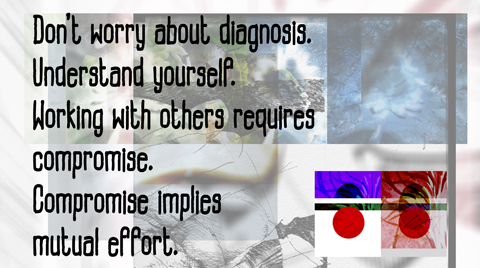
Don’t worry about diagnosis. Understand yourself.

Working with others requires compromise. Compromise implies mutual effort.

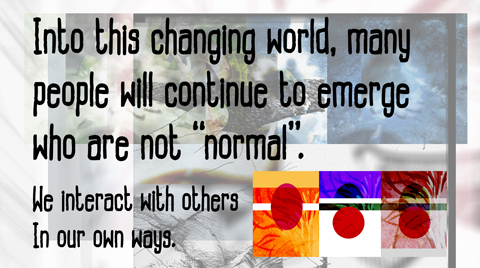
Into this changing world, many people will continue to emerge who are not “normal”. Some day there will be no “normal” that will develop from formulated expectations.

Someday, “normal” will mean different and unique.

That will be a beautiful day.

We work with others in ways we cannot always perceive immediately.

We interact with others in our own ways.

What a beautiful day.

(this post is part one of a script for an upcoming video on autism, asperger’s syndrome and adhd. the preliminary version of the video may be viewed here.)


Teaming Up With Teachers

My son received an autism diagnosis in 2000.

In the years since, he’s attended public schools, from Pre-K onwards. We’ve traveled 3 school systems and a range of settings: self-contained classrooms, resource classes with dedicated paraprofessionals, resource classes with shared paras, and independent work in regular classrooms.

We’ve met a variety of teachers, from passionately enthusiastic young recent graduates to seasoned veterans nearing retirement.

Throughout the whirlwind of changes (of schools and teachers, as well as the changes through growth), I’ve seen one principle proven over and over again:

You catch more flies with honey than vinegar.

Please pardon my pun. Baseballs and insects often collide, but teachers are not flies; they are kind people who do their best to work with our kids.

Baseball games let people understand the yearning of learning: the yearning to know what’s coming next, the yearning for the dull boring part to end, the yearning to get on with the game. I know parents yearn in this way for their children; I imagine teachers yearn for this too.

Last week my son had an outburst in a busy classroom. It shocked the teachers; that was their pop fly. My son still feels caught: caught between his own frustration in the class and his own understanding of consequences. He will probably remember that “out” for years.

Over a decade, we’ve fielded a lot of pop flies and thrown a lot of balls. Different circumstances and levels of exhaustion provoked an assortment of responses with sometimes-unexpected results.

Our pop flies usually come in the form of emails. As parents, we have the luxury of learning about incidents once the teachers have had a chance to catch their breath. We catch the fly ball and take a moment to decide what kind of ball we’re going to send back: a screaming scorcher, a gentle lob, or something in between.

On some level, we make a decision: is this a competitive sport, or a team effort?

When this happens, I try to remember: this is not about “me”. However I respond, my son is the one who will face the “umpire” the next day at school. And the ump will have to deal with my son.

The “umpire” is not just a body in a funny striped shirt. We’re talking about a human being who fills the shoes of teacher, umpire, coach, friend, and protector. There are probably other roles I don’t even know about…

So, when I feel a pop fly coming, I put out the honey, dust down my motherly defensiveness, and catch the fly.

To all the caring teachers in the world: Thank you for fielding my son’s throws, and for being his parent when I can’t. I know his throwing arm wobbles sometimes, and you really have to run to catch that ball.


I came across this recent post by Seth Godin:

Seths Blog: Three ways to help people get things done.

It caught my interest for selfish reasons… I’ve had some run-ins with bullies and extortionists in life, so I love the third method he proposes… “Open the door”…

As I was closing the window on the post, I realized, Damn, this applies to working with Autism… I wonder if he knows that…

Now I don’t delude myself with the idea that Seth Godin might give a rat’s patooty what I think, but I will question one aspect of his Open Door Policy:

What kind of expectations do people need to have others place on them, before they will strive to achieve their potential?

My son is merely one child/young man with autism, and we’ve worked with him in a fairly isolated fashion… But that kid has done some amazing things. And I’ve found that he flourishes exponentially better when the expectations are quite minimal, and the love, affection and acceptance are abundant.

If Seth’s “expectations” are to “accept and love yourself”, then he’s got one helluva business/life model there.


I put together this little video

We had a remarkable snow here in Atlanta a week or two ago.

On one of my walks I was struck by the sight of the melting snow running undernearth the crust of ice on the street.

It looked like the pavement was crying… reminded me of an essay I had written on Heartbreak


Think about how much an active womb resembles a roulette wheel. The shape, the throwing of the ball into the bowl, the chances taken – all of it fits on some level.

I believe I know why I’ve never heard of a gambling-themed baby shower.

Just the same, I can think of three ways parenthood resembles a trip to Biloxi. Thrilling uncertainty: it lures even “practical” people into wild visions of delight. The chance of walking away with a “gift”: this appeals to anyone with a shred of longing. But the willingness to accept any outcome… now that, ladies and gentlemen, really brings the analogy home for me.

When we’re expecting, we examine many things, just as others examine us. Of all the wonderful explorations that occur around conception, birth and growth, my most riveting came from one question: “Am I ready to – consciously – surrender the rest of my life to uncertainty?”

Parents never discover the effect their little bundle of joy will have on their lives until it arrives. Then we often – unconsciously – commit to fulfilling all the expectations of others and ourselves. Most of these expectations catch us unawares after we’ve walked away with the winnings. Sure, we can make decisions. We can decide what numbers to play. But if we think that gives us control, we’re kidding ourselves. Children have an amazing knack for dropping into whatever slot on the wheel they pick, regardless of where we placed our hard-earned cash. Even when all the medical screenings come back bright and cheerful, and even if our DNA seems promising, we cannot predict how many times we’ll have to keep our cool in the toy aisle. Or take a deep breath when our teenager has a meltdown. Or watch our 3-year-old undergo general anesthesia.

If you can walk away from a table in Biloxi empty-handed and still say you had a good time, then you’re ripe for parenthood (and life). No matter the outcome, we can find ways to experience our children as amazing gifts and teachers. No amount of cash winnings can compete with that. Actually, children emerge to surprise and test us. This may come as a surprise, but your roulette wheel is biased. And it’s also all arranged in advance. That’s the funny part: we get exactly what we asked for. We just didn’t anticipate how our wishes would come true.

For instance, I went through years trying to figure out the cleverest way to please the most people, so that my life could be predictable and “successful”. In 2000, my son received an Autism diagnosis; he quite often rolls outside the region of expectation and predictability. Yet every time I stop cringing in dread of unpleasant outcomes and uncover my eyes long enough to see how we’re doing, what do I see? This beautiful boy instinctively understands and lives what’s important… and makes good grades too. Over the years, I’ve noticed that every one of his little “quirks” seems to directly address one of my hang-ups. One by one, he helps me release them. What a selfless gift.

The most powerful blessing arrives with the attitude that accepts whatever arises.

Can you imagine a roulette gambler expecting to control the spin of the wheel and the settling of the ball? Expecting to know how children will turn out creates a similar invitation to learn first-hand about odds. It’s so tempting to plan, hope, dream, and use our children to define ourselves. That’s the giddy anticipation part. Yet those expectations hold no sway over how life unfolds. Parenthood sometimes seems to imply responsibility for the outcome. I visualize gamblers glaring at each other once the ball settles onto its number, as if one of them made it fall right there, right then. Somehow, it’s much easier to laugh at that image than to chuckle at our own unvoiced expectations surrounding parenthood.

When we view parenting like placing a bet on a wheel, we give ourselves permission to have no idea what will come our way. ‘Permission’ plays a key role in how much we enjoy our spin of the wheel. Feeling permission to wonder, question, and observe liberates us. Releasing self-expectation is one of the most generous and liberating acts a parent can perform.

For anyone who experiences an exuberant moment, learning that she/he faces the prospect of parenthood, it’s worth also taking a pregnant pause. Consider the deep blessing of meeting uncertainty as teacher, and that you’re about to get your butt kicked by having your wishes fulfilled. Embracing the uncertainty of parenthood states that you’re willing to take whatever may come, place your bets, and continue breathing while the wheel slows and the ball gets ready to drop.