Archives for category: The Mind

“Autism”

Diagnoses & prevents people who prefer higher guidance to the rote of the world.

Who waits when the Divine calls?

Thank your open mind for hearing and seeing this message.

There will be no more mis-diagnoses

(manipulation…?)

when you accept all things engaging in possibility.

fear… genocide… war…

all disappear…

If you ignore possibility, chaos ensues.

The old paradigm describes that the meaty stuff lies in the realm into which all things fall.

We all receive lessons and information constantly from a realm in which all things arise.

Your higher guidance brings you there.

Slip into your inner world

Speak when you need to share, tune out the meaningless noise.

It’s your intuition calling.

Fiddle with that toy on your desk. Let your fingers tap and your knees bounce up and down.

Let your fingers tap.

Let your mind wander.

Let yourself go.

What do we ignore so powerfully that our teachers must appear like this?

This world emerges from your thoughts.

Everyone appearing to you is your teacher.

(this post is part one of a script for an upcoming video on autism, asperger’s syndrome and adhd. the preliminary version of the video may be viewed here.)


Let’s begin at the end of questioning.

All people have a place of peace and learning.

A quiet peace is acceptable to others. Disruptive peace calls for diagnosis.

When someone receives a diagnosis of Autism, Asperger’s, or ADHD, the world changes for them and others.

Diagnoses may lead to labeling; labeling may lead to stereotyping; stereotyping may lead to dismissiveness.

Everyone in this world is unique. Everyone in the world deserves to be recognized as a unique individual.

Developing and receiving diagnoses changes the world. For adults, receiving a diagnosis can be like finding a missing puzzle piece.

It may also bring relief and understanding. It may project confusion and fear. It may arouse resistance to being “labeled”.

We don’t always notice when we perceive things differently from those around us.

How does one learn he’s colorblind?

Or deaf?

Don’t worry about diagnosis. Understand yourself.

Working with others requires compromise. Compromise implies mutual effort.

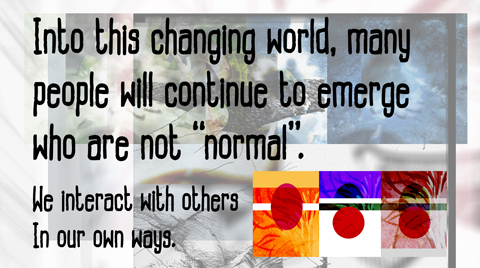
Into this changing world, many people will continue to emerge who are not “normal”. Some day there will be no “normal” that will develop from formulated expectations.

Someday, “normal” will mean different and unique.

That will be a beautiful day.

We work with others in ways we cannot always perceive immediately.

We interact with others in our own ways.

What a beautiful day.

(this post is part one of a script for an upcoming video on autism, asperger’s syndrome and adhd. the preliminary version of the video may be viewed here.)


Thank you, Elizabeth, for the wonderful idea of using my artwork as blog posts!

For three weeks now I’ve been scrambling double-time, writing frantically and then scurrying to create original images for the posts… It never occurred to me that folks might just enjoy the images for their own sake.

I made this sketch yesterday while waiting on a bookstore to open… One of my friends was really on my mind, and I sketched, wishing the love that I was putting into the sketch to find its way to them.

I was thinking about how often we move through sadness and confusion and fear to get to better places. Along the way, the world can feel dark and terrifying.

Sometimes when we detect the tiniest tear in the veil of illusion of this world, the shaky ground seems to yield into abyss…

This afternoon, I added color to the sketch… You’ll get to see it in a couple days!


CHANGE AND DIFFERENCE 01…

“Change and Difference” is a series of sketches I did in 1986, when I was trying to make sense of my feelings and intuitions about life.

I’m only now able to even attempt to put words to the images…

I’ll post these sketches in four strips over the next week.

Progress is Good.

1. awakening

2. stirring

3. confusion


How to get outta this place…

When I was a child, I loved this particular part of church services: opening the hymnal as the organ’s chords filled the space.

The sanctuary filled with voices of all qualities singing beautiful hymns, and I felt wafted away on the promise of possibility.

Kirtan, Qawwali, and Buddhist chanting affect me the same way. And wonderful new music can be found that transports through hip-hop beats and ambient sound.

At some point recently, I noticed that I prefer music with incomprehensible lyrics or vocalizations. Why on earth would I rather NOT understand the verbal message?

I meditated (thought) about this a bit, and noticed that music conveys its message not only through the precise meaning of the words, but through the many layers of beat, melody, harmony, surprise, tone, timbre, key, note… every abstract bit and aspect of sound and mood flows into music to open our minds.

I’ll share my personal favorite: Rachid Taha’s music. I know a little about him, and have all of his albums (that I can find). I understand  a little about the situation of Muslim Algerian ex-pats in France. But unless the words are in French (or I look it up online), I have no idea what his lyrics – literally – mean.

And that’s okay. It actually helps that I’m clueless.

When I listen to Taha’s music, I receive this: an underlying  chorus of joyous tenacity that tells me that life is worth living, no matter how angry we get, no matter what we lose in the process of following our dreams, no matter what kind of crap we have to put up with along the way.

Music offers this by re-routing our rational, left-brain thinking and pumping all we’ve got into the right brain…

Into the body.

Music engages the entire body, to dis-engage us from our sense of “is that all there is?”.

Instead, music gives us possibility.

So go on and tap your fingers and toes, and sway side to side. Let music take your entire being to the play and places you really want to go.

(For more esoteric explanations, please check out this post and this post. Thanks!)


WordPress offers this topic for today’s Post A Day 2011 exercise:

Is it always better to know the truth, even when it hurts? Or is ignorance bliss? Or are they both true some of the time?

I thought this would be a quick, easy post – short and to the point. But the more I think about it, the longer it’s getting… So I’ll get the short and to-the-point bit out of the way in the beginning, and save the personal-experience bit for the end, for those who have the time. There’s also a link to one of my videos down there – thank you if you have the time to check it out!

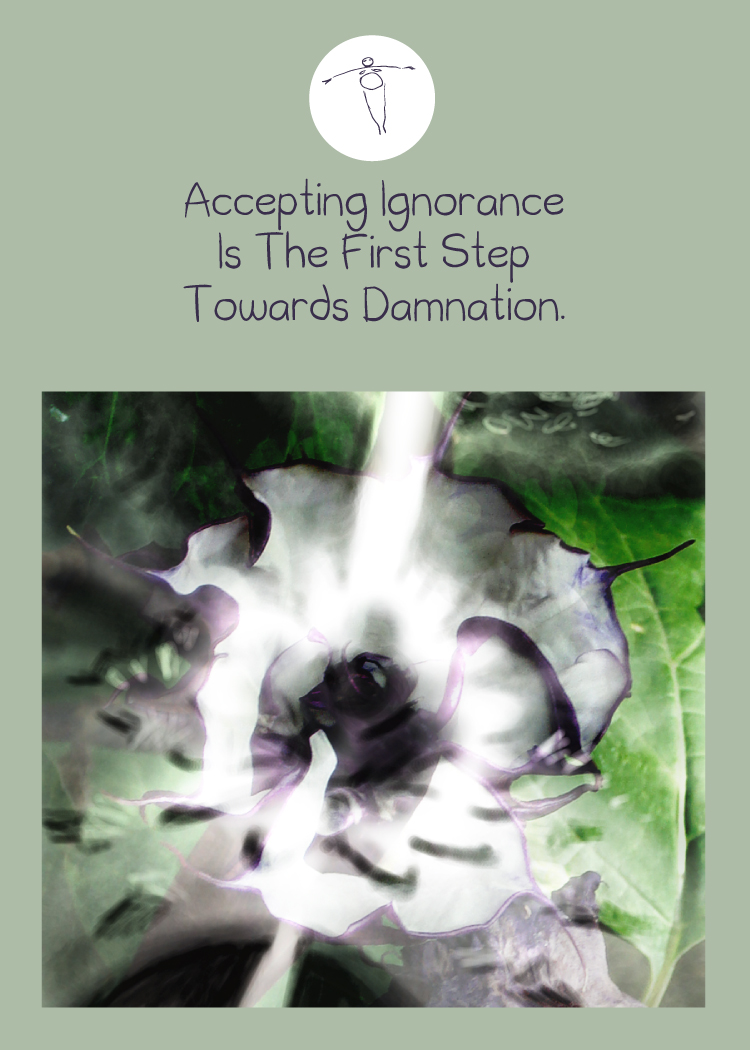
Last fall I created a series of inspirational cards about Using The Mind (the images can be found on Flickr), and one of the cards elicited a number of questions:

“Accepting Ignorance Is The First Step Towards Damnation.”

Several people asked about the use of the word “damnation”…

It’s a strong word; thinking about damnation probably falls way down near the bottom on most people’s to-do list.

I was given the word, and questioned it myself at first…

(It came from one of my guides; I talk about him a little in this post on my other blog)

I think I was given such a strong word precisely so that it would catch attention and encourage people to think and question.

“Damnation” refers to the state of mind in which we seem to find ourselves in constant, pervasive conflict with the world around us. In this state, we struggle continuously against the lessons that come our way.

“Accepting Ignorance” refers to the state of mind in which we feel we must submit to the expectations of others without questioning.

As we go through life, if we take the view that every experience offers a lesson intended to lead us to true happiness, we can refresh our feelings about the challenges we face.

Zen koans lead us to understanding in a similar way: the teacher poses a question… We quickly find out that we can’t reason our way to the “answer”… we might even get angry and frustrated that the answer’s not coming freely… finally we realize we need to “go inside” to get to our own answer. And our answer might be different from another’s… Damn.

Life resembles a vast, unrelenting koan. Again, again, again, we run into riddles. How do I answer that question my boss just asked? Do I let the baby cry himself asleep? Is red meat really bad for me… always? Who on earth should I vote for?

If we expect clear-cut answers that arrive effortlessly, we’re damned.

Damnation and Hell are states of mind. Ignorance is a state of mindlessness.

We can find ourselves living in a quiet, subtle hell if we live a life that goes against our grain, without questioning and being willing to take risks in order to extricate ourselves from that hell.

Here comes the personal-experience part…

Sometimes in life, we’re faced with situations in which we must make decisions, and we really wonder about the consequences. For instance, I was a Buddhist nun for 4-1/2 years, and in the tradition I had joined, to “disrobe” means certain damnation (in the sense of going to “hell”)…

(btw, Buddhist traditions vary on their views on this matter, not all hold this belief)

I enjoyed being a nun, and I really did expect to continue nun-hood for the rest of my life. I love teaching and helping others, and it seemed I had found a wonderful outlet for that. As the years passed and I gained more experience in the more advanced teachings (emptiness, Vajrayana, etc.), I began to feel called to move back out into the “world”, and connect more with people who might not be drawn to formal Buddhism. I had found that with some people, the robes and shaved head created unnecessary distance. Or worse, a sort of reverence that was bestowed arbitrarily. Robes=perfection. Not true. Need to question.

I began to see that I was most likely going to decide to return my vows.

I considered the decision for about a year… I had been reading, studying, meditating, teaching, practicing for several years. Making spiritual progress was really what mattered to me most. For a few years, I had been nearing the conclusion that my Guides (whom I had met through that tradition) were pointing me in the direction of moving beyond that tradition. Did that make sense?

Conflict and contradiction presented themselves constantly. I felt I knew clearly what my next step needed to be, but it didn’t make sense that it would involve cutting away from my beloved friends and teachers (another tenet of that tradition is that if you “disrobe” you must separate from the community completely for at least a year afterwards), and subjecting myself to a state of “damnation”.

That lead me to think a lot, that year, about the nature of “damnation”. And “Hell”. And that’s how I arrived at the understanding I share above.

I realized that the real shame, the real damnation, would be if I chose adhering to expectations (including mine) over continuing to learn and grow, and venturing into the unknown.

So I took the step outside the circle. I knew I was well-guided, and that eventually I would find a way to connect directly with those who could help me the most. I could feel the invisible hand, and that it belonged to a “being” that was more vast, profound, and powerful than words, images, or music could describe. I knew we would meet, and that we would meet on a ground that was free from the constraints of any formal religion or doctrine.

And we did meet, after a bit of stumbling.

In the three years since I returned my vows, I’ve discovered that the rocky road can lead to peace. I’ve learned that intention is everything, and as long as we strive to improve ourselves, be kind to others, and give when we can, then a state which others may perceive as “damnation” can feel like a profound blessing.

Knowing that you’re guided is the most important point to understanding that damnation is only for the ignorant, those who refuse to question. Our guides pose the riddles that we ponder day and night, and if we hold this view, it can help us understand that even the most baffling and painful challenges are lessons that are as illusory as dreams.

I’ve been making videos to share some of what I’ve learned, and this one uses the ideas from the “Using The Mind” card series. It’s almost 5 minutes long, and each of the 12 points is intended to provoke thought, rather than provide pat answers or “instructions”. If you find the time to watch it, I hope you enjoy it and find it helpful. I’ve almost completed another video, titled “Vows”… you can guess what that one explores!

Thanks to everyone reading these blogs – I feel so fortunate to have found a way to share, and if it manages to help anyone – in even the smallest way – to discover more happiness, then… very good! In turn, I have my guides to thank, for showing me that anything is possible.

Think about how much an active womb resembles a roulette wheel. The shape, the throwing of the ball into the bowl, the chances taken – all of it fits on some level.

I believe I know why I’ve never heard of a gambling-themed baby shower.

Just the same, I can think of three ways parenthood resembles a trip to Biloxi. Thrilling uncertainty: it lures even “practical” people into wild visions of delight. The chance of walking away with a “gift”: this appeals to anyone with a shred of longing. But the willingness to accept any outcome… now that, ladies and gentlemen, really brings the analogy home for me.

When we’re expecting, we examine many things, just as others examine us. Of all the wonderful explorations that occur around conception, birth and growth, my most riveting came from one question: “Am I ready to – consciously – surrender the rest of my life to uncertainty?”

Parents never discover the effect their little bundle of joy will have on their lives until it arrives. Then we often – unconsciously – commit to fulfilling all the expectations of others and ourselves. Most of these expectations catch us unawares after we’ve walked away with the winnings. Sure, we can make decisions. We can decide what numbers to play. But if we think that gives us control, we’re kidding ourselves. Children have an amazing knack for dropping into whatever slot on the wheel they pick, regardless of where we placed our hard-earned cash. Even when all the medical screenings come back bright and cheerful, and even if our DNA seems promising, we cannot predict how many times we’ll have to keep our cool in the toy aisle. Or take a deep breath when our teenager has a meltdown. Or watch our 3-year-old undergo general anesthesia.

If you can walk away from a table in Biloxi empty-handed and still say you had a good time, then you’re ripe for parenthood (and life). No matter the outcome, we can find ways to experience our children as amazing gifts and teachers. No amount of cash winnings can compete with that. Actually, children emerge to surprise and test us. This may come as a surprise, but your roulette wheel is biased. And it’s also all arranged in advance. That’s the funny part: we get exactly what we asked for. We just didn’t anticipate how our wishes would come true.

For instance, I went through years trying to figure out the cleverest way to please the most people, so that my life could be predictable and “successful”. In 2000, my son received an Autism diagnosis; he quite often rolls outside the region of expectation and predictability. Yet every time I stop cringing in dread of unpleasant outcomes and uncover my eyes long enough to see how we’re doing, what do I see? This beautiful boy instinctively understands and lives what’s important… and makes good grades too. Over the years, I’ve noticed that every one of his little “quirks” seems to directly address one of my hang-ups. One by one, he helps me release them. What a selfless gift.

The most powerful blessing arrives with the attitude that accepts whatever arises.

Can you imagine a roulette gambler expecting to control the spin of the wheel and the settling of the ball? Expecting to know how children will turn out creates a similar invitation to learn first-hand about odds. It’s so tempting to plan, hope, dream, and use our children to define ourselves. That’s the giddy anticipation part. Yet those expectations hold no sway over how life unfolds. Parenthood sometimes seems to imply responsibility for the outcome. I visualize gamblers glaring at each other once the ball settles onto its number, as if one of them made it fall right there, right then. Somehow, it’s much easier to laugh at that image than to chuckle at our own unvoiced expectations surrounding parenthood.

When we view parenting like placing a bet on a wheel, we give ourselves permission to have no idea what will come our way. ‘Permission’ plays a key role in how much we enjoy our spin of the wheel. Feeling permission to wonder, question, and observe liberates us. Releasing self-expectation is one of the most generous and liberating acts a parent can perform.

For anyone who experiences an exuberant moment, learning that she/he faces the prospect of parenthood, it’s worth also taking a pregnant pause. Consider the deep blessing of meeting uncertainty as teacher, and that you’re about to get your butt kicked by having your wishes fulfilled. Embracing the uncertainty of parenthood states that you’re willing to take whatever may come, place your bets, and continue breathing while the wheel slows and the ball gets ready to drop.


So, I was talking with my friend John the other day, and I mentioned that I tend not to like to have long phone conversations. His reply: “Yeah, I noticed…”

Food for thought.

I think that tendency comes from a few sources.

The first would be phone conversations with “boyfriend” in high school… You know the kind: “So, what are you doing?” “Oh, nothing.” “Yeah? And what are you doing now?” “Oh, just listening to you…”

The second source could be years of studying and practicing Buddhism, 4-1/2 of which I spent as a nun, while much emphasis was placed on avoiding “meaningless activity” and “meaningless speech”… I generally didn’t watch TV (which is why I still think of buildings first, when I hear the word “House” – I was an architect, too) or spend time on the internet (which is why I feel like a real dinosaur as I jump into this postaday thingy).

The third source comes from spending years as a workaholic single mom of a child with special needs – I often just didn’t have the time.

Now that I’m back “in the world”, I’ve got a lot to learn about it (especially as others experience it), and I’m learning the value of friendships and connecting with others.

Several of my new blogging buddies write about getting pissed off, the mind, and  dreams (one of my favorite topics and a new category to add!). I’m finding there are more people out there of like minds than I imagined.

So I’m getting back on the “phone”.

Cheers!